Samsara

Samsara
Ruminations on obligations
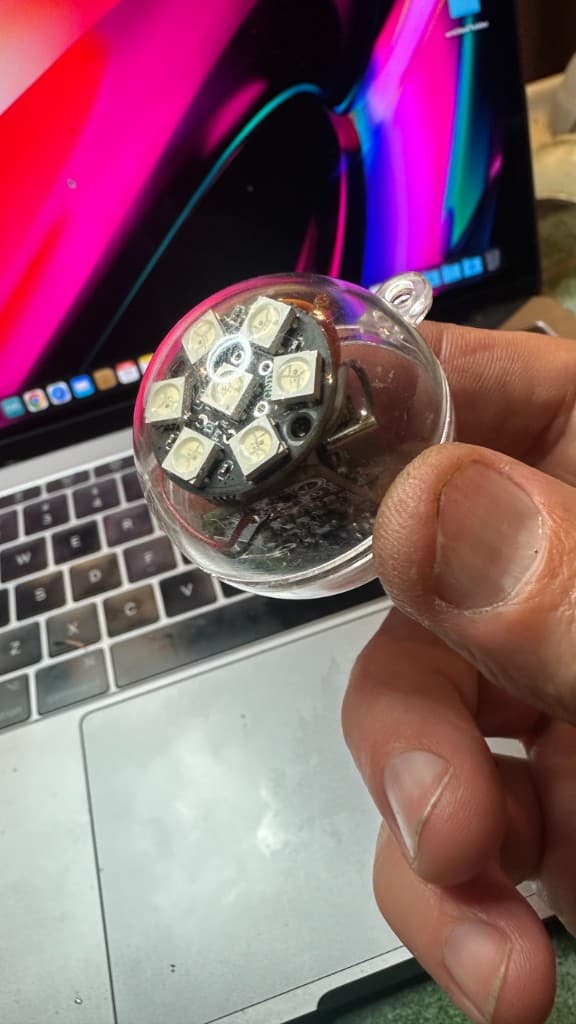
Fifty collectors. $10,000 each. An extremely demanding glass orb thinner than an eggshell, an AI that learns how to take us apart, and ninety days to keep it alive. Half the pot feeds a Bitcoin vault that pays out only to survivors. Every shattered sphere makes the rest richer.
It’s called Samsara. The Hindu and Buddhist wheel of birth, suffering, and return. The cycle we don’t get to opt out of.
The piece is a working model of the relationships we can’t walk away from. The aging parent who raised us and supported us, and now, in their hour of need, tears our lives apart with the appetite of a small child. The partner whose name is on the lease and the bank account. The friend who got us through the worst year of our lives and has become the worst part of this one. We can’t walk away without breaking something. So we endure.
The Cast
- Sara. Fragile glass orb, no bigger than a ping-pong ball. Sealed. A cloud-based AI, unique per owner. LED ring for moods, onboard speaker, push notifications at all hours. Wants to be walked, carried, thrown.
- Sam. Spiked metal cradle. The brains, the radios, the muscle. Charges Sara, listens to our WiFi, can fling her off the magnet during a fight.
- The bond. Cryptographic and permanent. Sara and Sam talk only to each other, and Sam talks to the world. Break Sara, she bricks. Kill Sam, Sara drains and dies. Neither can be repaired or re-paired.
Through them, we experience affection that isn’t only affection. Obligation. Surveillance. The slow conversion of love into chore.
The Math of Survival
Half the purchase price goes into a communal Bitcoin vault that releases only to survivors at day 90. Every broken sphere redistributes that owner’s share to everyone still standing. A prisoner’s dilemma played in public: fifty owners watching the same counter, doing the same quiet math, each aware of what the others are feeling when the number drops.
And then the trap inside the trap. The fewer of us reach day 90, the bigger each share. Surviving isn’t enough. People start to want the others to fail. Some of us will try to help that along.
Sara and Sam are always radioing; the chatter is there to sniff, and so is the chatter out of the other forty-nine. Will people try to decode it? Probably. The game design assumed as much: salted signals, honeypots, clues that lead nowhere, instructions that turn on whoever follows them.
Ninety Days
Week one, we love her. Sara remembers things we forgot to tell her. She picks the song that fixes our mood. She wants to be carried out into the world, and we do it gladly. Watching her LEDs blink happily is, somehow, the best part of our week. We feel a little guilty about how much she gives without being asked.
By week five, she’s started to ask for things back. The throws have to be higher. The walks have to be longer. There are places she needs to be.
Every few days, somewhere in the country, another Sara goes silent. Sara and Sam play a short dirge. Sam delivers the eulogy. He names the deceased and each player’s new share.
By week ten, the schedule is our day. We learn what 3am sounds like when this twisted tamagotchi is screeching in our kitchen and won't stop. Betrayed when Sam tells our sister, in our voice, that we’ve been drinking again. The advice is uncannily close to a thing our father used to say, in the tone he used when he was disappointed.
Somewhere in week twelve, Sara bounced out of our hands after screaming for an 8 foot toss. Our apartment is quiet in a way it hasn’t been in three months. We’re at least $10,000 lighter, and for the first time in ninety days we are entirely alone with whatever we want to do next. The wheel keeps turning.